Middle Shooks Run is a neighborhood built on the strength of working-class families. Slowly forming along the banks of a creek and beside the Santa Fe Railway tracks since the earliest days of Colorado Springs, it endured decades of underinvestment and shifting city priorities. Through it all, many residents remained.
We have built something that cannot be measured on a balance sheet: social capital—a network of neighbors who have invested time, care, and commitment into this place. That accumulated kinship is our greatest asset.
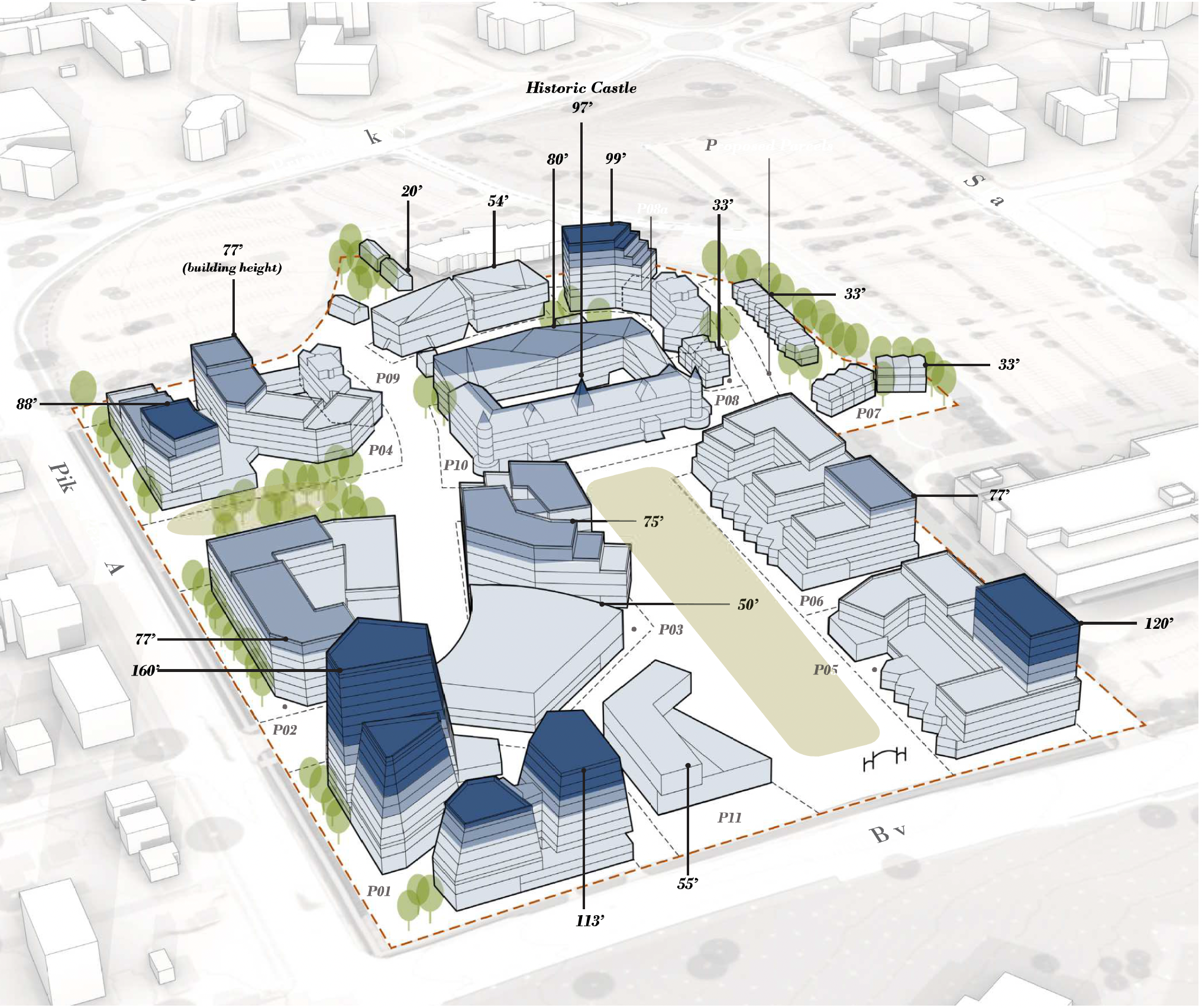
There is a development project a half-mile east of our neighborhood, across Memorial Park, that will reshape our part of Colorado Springs. The proposed $1 billion redevelopment of the Union Printers Home (UPH) site by UPH Partners represents one of the largest investments in our community’s history. The project aims to renovate the old ‘castle’ building into a hotel and add mixed-use commercial and residential buildings where there is now lawn and old trees. The partners are local entrepreneurs, and their approach has been thoughtful and incorporated community outreach. But the magnitude and proximity of this proposal brings us to an important moment: determining how we can retain agency in our growth. We must understand and engage in the development process while creating opportunities for small-scale redevelopment.

Two important forums for neighbors to influence development are through Planning Commission and City Council public hearings, where plans are approved or denied. The development plan was approved by City Council at a public hearing on June 25, 2024.1 That approval included a zoning change to Mixed-Use Large and a development standards adjustment allowing a maximum building height of 160 feet. At the hearing, three citizens spoke in favor of the project and one written comment was submitted in opposition. This means that the UPH redevelopment plan has the green light and there is no further community input required to proceed.
However, the developer has now applied to the Colorado Springs Urban Renewal Authority (CSURA) for financial assistance by submitting a Proposed Urban Renewal Plan. This application provides neighbors with another opportunity for engagement, as public hearings will be held before CSURA, the Planning Commission, and City Council prior to final approval.
A Model of Growth That Fits Our Neighborhood
MSRNA believes in a growth model that is distributed and steady.
Middle Shooks Run was not built by a single transformative investment. It evolved gradually over more than a century by neighbors adding rooms, opening small shops near streetcar stops, building duplexes, churches, and gathering spaces. These incremental decisions, repeated by many hands, shaped the neighborhood we cherish today.
When you know the local entrepreneur who lives two blocks over on Willamette Ave and wants to open a small shop in the neighborhood, you can ask them questions when you see them at Switchback Coffee. You might talk about construction noise or job opportunities. Local entrepreneurs and small-scale ownership offer more agency and trust within a community.
We value 1,000 developers making $1 million investments across our city more than one developer making a $1 billion investment in a single place. This approach spreads opportunity and risk rather than concentrating both in one location. Large, concentrated developments rely heavily on formal city processes to balance competing interests. But to many residents, that process can feel opaque and distant. Contention over developments often stems not from malintent, but from a community’s feeling of powerlessness against experts, big money, and unfamiliar developers. These are all symptoms of excessive scale.
Growth requires capital. We welcome investment. We favor investment that is locally rooted, distributed, and aligned with neighborhood capacity.
Magnitude matters. Pace matters.
A massive, concentrated investment will create change quickly—potentially faster than neighbors can adapt to rising costs and shifting market pressures. When neighbors leave, we lose relationships, stability, and the social capital that makes places vibrant and unique. However, when residents remain and pursue opportunities close to home, we stockpile wealth and build culture. It is this solid foundation that initiates upward mobility—not speculative turnover—that fosters lasting prosperity.
Our story is similar to the neighborhoods adjacent to the UPH project: Knob Hill, Hillside, and K-Land. These communities were shaped gradually by ordinary people making steady, long-term commitments to their neighborhood.
The question before us is not whether growth will occur, but how it will occur, whom it will serve, and whether current residents will meaningfully share in its benefits. Ideally, the residents who built this neighborhood should be able to remain and benefit from its improvement.
The Urban Renewal Process in Brief
Understanding the financing structure helps identify additional opportunity to engage.
Bottom line: The CSURA helps developers secure the necessary funding to complete projects that align with the authority’s mission.
The urban renewal process begins when a developer establishes a plan and project budget, including anticipated profit margins. City planning requirements and negotiated public benefits, such as historic preservation or open space, may affect overall feasibility. If projected returns are insufficient to attract capital at the proposed scale, a developer may submit an Urban Renewal Plan to CSURA seeking assistance to fill a financing gap.2 As part of its initial city planning approval, UPH Partners committed to on-site amenities including public open space, public art, community gardens, mini-park plazas, and enhanced architectural design.
To qualify, the proposed project area must meet Colorado statutory criteria for blight. The statutory definition of “blight” is technical and does not necessarily reflect neighborhood vitality. If accepted for consideration, a Conditions Study (Blight Study) is conducted. If blight is found, the project may proceed to financing review, by a third party, for the CSURA.
CSURA primarily utilizes Tax Increment Financing (TIF) in accordance with Colorado Urban Renewal Law to provide the money for approved projects. TIF allows CSURA to capture the increase in property tax revenue above a pre-development base level for up to 25 years, revenue that would not have existed but for the redevelopment. That new tax revenue, which would otherwise flow to taxing entities such as the city, county, and school district, is used to repay bonds or reimburse eligible redevelopment costs. In most cases, these obligations are payable solely from the increment itself, not from the City’s general fund. The amount captured and the participation terms are negotiated between CSURA, the developer, and affected taxing entities.3
During the life of an urban renewal area, however, the new tax growth represents a meaningful opportunity cost to public services. The good news is that at the end of the term, all new tax revenue reverts to its original taxing entities.
The Paradox of Public Financing
There is an inherent tension within the TIF mechanism. The neighborhoods surrounding the UPH site include some of the lowest-income areas in our city. Yet public financing is being considered to support a luxury hotel, high-end office and residential buildings, and other premium amenities.
If the Urban Renewal Plan is approved, property values will likely rise, which can contribute to higher rents and property taxes nearby. Neighbors already living on the margin could face mounting financial pressure. Homeowners may be incentivized to sell. Renters may struggle to remain. Over time, the social capital that defines these neighborhoods could erode.
When new money enters a community, it should lift up those who sustained its value through the lean decades, not extract that value for concentrated gain.
When investment is concentrated and supported by public subsidy, the community must be intentional about how benefits are shared. If a project requires substantial public assistance to proceed at its proposed size, we should ask whether that size is appropriate. Public participation should result in public prosperity.
The Role of a Community Benefits Agreement
When projects become outsized relative to the community in which they are proposed, the traditional public planning process can fail to provide meaningful avenues for resident participation. While public hearings offer procedural opportunities for input, they rarely grant communities leverage to shape specific substantive outcomes.
One way to ensure meaningful participation is to facilitate the creation of a Community Benefits Agreement (CBA) as a condition of Urban Renewal Plan approval—or to incorporate negotiated provisions directly into the Plan itself. A CBA is not designed to obstruct development, but to align it with community priorities. When residents believe they can influence outcomes, engagement increases.
The neighborhoods of Knob Hill, K-Land, and Hillside have formed the UPH CBA Coalition and are working toward a CBA with the developer. MSRNA stands as an ally in their effort to negotiate benefits that mitigate potential negative externalities while capturing a share of the project’s economic value.
A well-crafted CBA is a legally binding agreement that can include:
- Commitments to local workforce utilization and apprenticeship pathways
- Participation by Colorado Springs–based contractors and design professionals
- Prevailing wage standards
- Transparent reporting of community impact metrics
- Housing attainability strategies aligned with neighborhood incomes
A CBA enables benefits that extend beyond traditional site amenities like parks and open space. It clarifies expectations early, reduces conflict later, and may help build trust between the developer, the city, and the community. If public financing tools are used, they should produce measurable public benefits, including strategies that enable neighbors to stay.
Looking Ahead with Lessons Learned
Our support of the UPH CBA Coalition will, we hope, not only result in an enforceable agreement but also build relationships and knowledge that serve our neighborhood in future proposals.
For example, Norwood Development Group is pursuing Urban Renewal mechanisms in the Mill Street neighborhood. The Mill Street Neighborhood Association and the Colorado Springs Pro-Housing Partnership are negotiating a CBA, yet the Urban Renewal Plan is scheduled for City Council review on February 24 without a finalized agreement. Once approval is granted, neighborhood leverage diminishes substantially.
Norwood also owns the former St. Francis Health Center4 property just south of Middle Shooks Run at 825 E Pikes Peak Ave. We anticipate future development and URA proposals there as well. MSRNA intends to be proactive—organized, collaborative, and prepared to engage early to ensure alignment with neighborhood priorities. We will assist in notifying and mobilizing neighbors to participate in meetings and hearings that affect our mission.
Our elected representatives, commissioners, city employees, and boards carefully consider development proposals. But try as they may, they cannot fully understand the texture of life in our neighborhoods as we do. It is imperative that neighbors engage in the process to impart their hard-earned knowledge.
Neighbors may not have the financial resources of large development teams, but we have the power of numbers. Let’s learn the process, build relationships, and strengthen grassroots engagement by showing up for one another.
We Invite You to Participate
Learn
Urban Renewal Teach-In by the COS Pro-Housing Partnership
Saturday, February 21 at 3:00 p.m.
The Chinook Center
2551 Airport Rd #107
Colorado Springs, CO 80910
Engage
City Council Meeting — February 24, 9:00 a.m.
Observe and sign up to speak in support of thorough negotiations with Mill Street Neighborhood prior to approval of any Urban Renewal Plan.
Contact
Councilor Brandy Williams (District 3) – brandy.Williams@coloradosprings.gov
All City Council – AllCouncil@ColoradoSprings.gov
You may wish to emphasize:
- The advantage of a CBA prior to approval of an Urban Renewal Plan
- Ensuring public financing tools deliver measurable public benefit
- Expanding opportunity and participation alongside redevelopment
Middle Shooks Run welcomes thoughtful improvement—growth that uplifts residents, honors our history, protects our character, and builds belonging.
We believe development works best when it happens steadily and with the people who already call this place home.
Let us stand together to ensure that the people who built Middle Shooks Run can afford to live, work, and stay here.
- https://coloradosprings.legistar.com/MeetingDetail.aspx?ID=1123764&GUID=A0909202-62BC-4D40-AFC4-3079BE1C3B97&Options=info|&Search= ↩︎
- https://www.bhfs.com/insight/colorado-supreme-court-ruling-alters-landscape-for-urban-renewal/ ↩︎
- https://renewdenver.org/wp-content/uploads/2025/12/DURA_Resource-Guide.pdf ↩︎
- https://gazette.com/2014/04/03/st-francis-hospital-property-in-colorado-springs-sold-old-gazette-site-under-contract-75c2a473-a660-5496-817d-be5ed5ddf333/ ↩︎

2 responses to “A Billion Dollar Deal: Defining Growth in Middle Shooks Run”
Not surprising that wrong neighborhood identified as the comprehensive neighborhood plan that preceded proposed neighborhood development contained many errors not yet corrected. One example was lumping Bonnyville with Kitty Hawk. Separated from each other by both the Rock Island rail tracks AND the Van Buren Ditch as well as at least a decade of building dates and totally different building styles (brick and split level dominating Kitty Hark and absent in Bonnyville).
Mr. Way (MSRNA Board of Directors),
We are new to Colorado Springs and were just made aware of this neighborhood organization. It is such a pleasure to be a part of this neighborhood and in particular one that has a rich history of community involvement and pride. The letter shared above is well considered – thank you. Please keep us posted on this project and if possible, an update on the City Council meeting that took place today. We look forward to meeting more of our Middle Shooks Run neighbors!