We celebrate and preserve the history that shapes Middle Shooks Run, recognizing that our stories and heritage give meaning to the present and guide the future.
To learn more, read the stories below, explore the Historic Places Interactive Map, or attend a Historic Education event.
Local History Stories
- Local History Stories
- Middle Shooks Run History Timeline
- Fannie Mae Duncan
- Middle Shooks Run Neighborhood in the 1940s
- “Sol’s Dairy”
- What’s Time to a Tree? (Or, The Story of Noah’s Bed)
- The Shook Brothers
- Institute Street and Electric Streetcars
- Frank Waters, Author, Grew Up in Shooks Run
- Historic Church – 527 E. Saint Vrain St.
Middle Shooks Run History Timeline
We are called “Middle” Shooks Run because our neighborhood extends along the middle part of Shooks Run creek from Uintah Street south to Pikes Peak Avenue.
1865
Peter & Denton Shook from Iowa locate cattle ranch on Fountain Creek. Tributary creek becomes
known as Shooks Run1871
City of Colorado Springs founded.
1873
William Clark starts Clarks Greenhouse. By 1898 extensive greenhouses on two blocks at Platte
Avenue & Wahsatch Street1876
Colorado School for Deaf and Blind established at 33 N Institute
1885
Shooks Run flash flood kills livestock, destroys property and took one person’s life
1887
Atchison, Topeka and Santa Fe Railroad starts train service along Shooks Run
1898
Columbia Elementary school built at Institute and Boulder.
1902
Streetcar service starts on North Institute Street
1902
Grocery at Willamette & Prospect opens and operates as grocery for more than 100 years (now
Stellina Pizza Cafe)1903
Boulder Street Church built by Presbyterians, later the home of People’s United Methodist Episcopal Church
1904
People’s Methodist Episcopal Church, the city’s third African-American church, built on St Vrain Street.
1922
North Middle School on Yampa Street opens
1939
Platte Avenue underpass opens, allowing vehicle traffic to avoid stopping for trains
1952
Fannie Mae Duncan, black entrepreneur, moves the Hart mansion to Corona Street
1970
Last train runs on AT&SF tracks
1972
Original Columbia Elementary demolished and replaced with new school
1974
Shooks Run Park & Trail completed
Fannie Mae Duncan
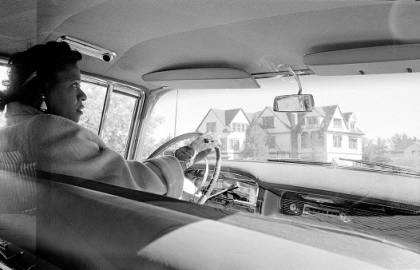
Fannie Mae Duncan (1918-2005) was a larger-than-life character who chose to live in the Middle Shooks Run area at 615 N. Corona. She moved to Colorado Springs in 1933 as a teenager with her siblings and their recently widowed mother. Duncan attended North Middle School and graduated from Colorado Springs High School (later Palmer High School). Duncan worked hard in the hospitality industry and eventually opened the locally famous Cotton Club, an integrated night club located on Colorado Avenue across the street from the Antlers Hotel. She and her family lived on the near westside at 702 Pine Street until she found a new house.
Duncan’s new home had been built in 1891 by Dr. James A. Hart at the corner of Nevada Avenue and Dale Street. Fannie Mae rescued the mansion from being torn down and moved it to two vacant lots at 615 N. Corona Street. With forty-three rooms and over 8,000 square feet, the house was so big it had to be cut into three sections to be moved. Duncan was excited to find the house that would be large enough to offer overnight housing to her club’s entertainers who had trouble finding overnight accommodations.
The vacant lots Duncan bought on Corona were in the “right neighborhood” according to Colorado Springs’ unspoken rules. She wrote in her autobiography, “For some reason it was okay for blacks and whites to live beside each other on certain streets but not on others. I don’t think the city was specifically zoned that way, but some things were simply understood.”
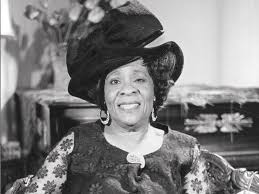
Urban renewal was the downfall of her nightclub on Colorado Avenue. In 1975 the property was taken “by right of eminent domain.” After 28 years, the club that had advertised “Everybody Welcome” was closed and the building was torn down.
Eventually, Duncan turned over her mansion on Corona to Bethhaven for use as a group home and moved to Denver to live with her sister. She was posthumously inducted into the Colorado Women’s Hall of Fame in 2012. Her fascinating story is told in “Everybody Welcome, A Memoir of Fannie Mae Duncan and the Cotton Club” by Fannie Mae Duncan with Kathleen F. Esmiol (published by Chiaroscuro Press, 2013) which includes a wealth of details and photos of Duncan’s life and family in Colorado Springs.
Middle Shooks Run Neighborhood in the 1940s
Some of us have a hard time imagining trains steaming through the middle of our neighborhood. Not so for Shirley Bonds who lived on N. Prospect Street at Monument since 1942. She was a native of Colorado Springs and moved to North Prospect from Cache La Poudre Street when she was 18 years old. Shirley recalled being awakened by the clanging of milk cans being dropped off and picked up at Sol’s Dairy at 5 o’clock in the morning; and she was quite knowledgeable about the history of the neighborhood.
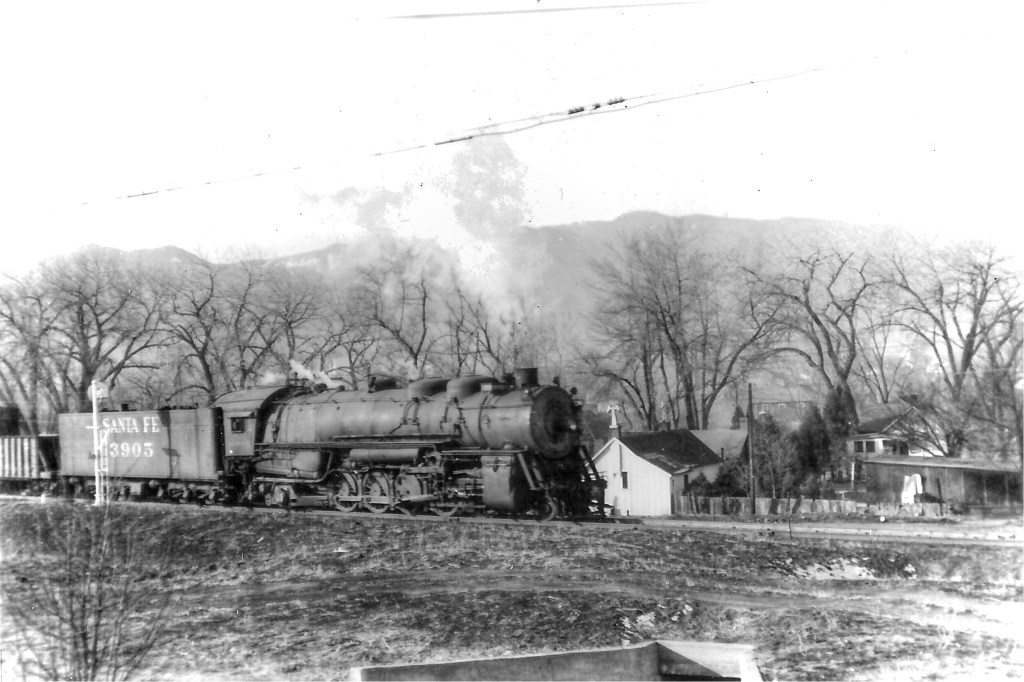
Shirley photographed the Atchison,Topeka, and Santa Fe steam engine and train passing through the North 600 block of Middle Shooks Run neighborhood during the 1940’s and the old Franklin Street neighborhood that was replaced by the Franklin Square Townhomes and North Shooks Run Park during Urban Renewal in the 1970’s.
“Sol’s Dairy”
by Louise Conner
For many years, in the 600 block of North Prospect Street there was a faded sign painted on the side of a small building that read “Sol’s Dairy.” Originally, Sam Rollins started the business in 1923 and called it Highland View Dairy.
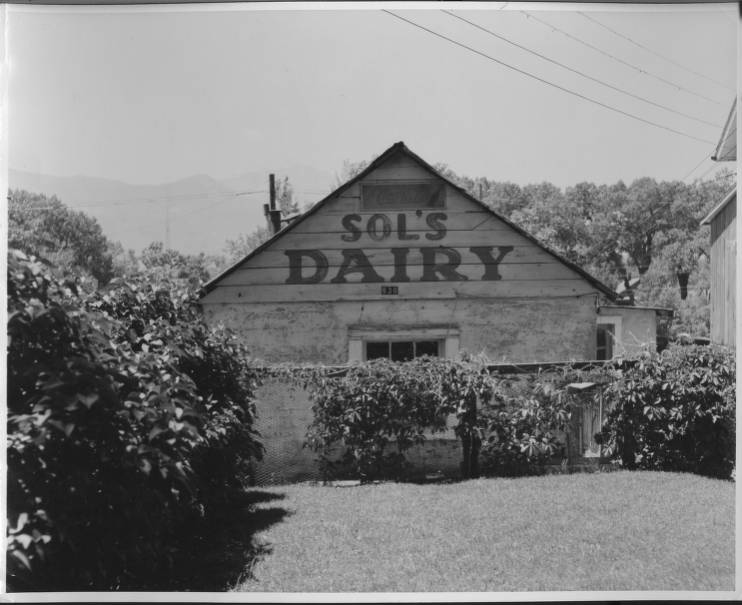
Decades later, Sam’s daughter Mary told Ruth Hadsall in an interview printed in Middle Shooks Run Neighborhood Association newsletter (Fall 1990) that farmers from surrounding farms brought in the milk which was processed at the dairy. Sam delivered the milk around the neighborhood in a pickup truck until he died of a burst appendix in 1929. Later, Mary’s mother Elizabeth rented out the dairy to Sol Cox, and his name stayed on the small building long after the dairy business ended in the 1950s.
Mary Rollins was born near Black Forest to Samuel and Elizabeth Rollins on December 1, 1915. She attended St Mary’s High School and graduated in 1934. Mary worked for the telephone company before marrying Claude Ford in 1941. Mary and Claude had two sons, grandchildren and great grandchildren.
Mary and Claude lived at 632 N. Prospect next to the dairy building for many years. An active member of St. Mary’s Cathedral, Mary gave many volunteer hours to the cathedral. She also catered and served many wedding receptions and bank luncheons. Claude died in 1992 and Mary died at the age of 95 on January 1, 2011.
The old dairy building was torn down in January 2012. Members of MSRNA took possession of the sign painted on a gable of the building. Work was done to preserve the sign and the Sol’s Dairy gable is now displayed at the xeriscaped garden at the corner of Willamette and El Paso Streets. A new home has been built at the old address, occupied by a new family.
What’s Time to a Tree? (Or, The Story of Noah’s Bed)
by David Ryan
Old trees don’t give up their secrets easily. But an old willow along the banks of downtown’s little creek, Shooks Run, has a particularly poignant story to tell. This old tree swallowed a bed (headboard, footboard, springs and all) more than one hundred years ago. Today, the rusted remnants of that bed can be found by anyone willing to walk along the banks of Shooks Run between Willamette Street and the Dale Street footbridge.
On July 25, 1885 an unusually violent torrent let loose on the land of H. T. Clark, who lived at the base of Austin Bluffs. At 9:00 p.m. the rain was so heavy, it filled a 16-inch-deep tub in an hour. The water swept through his ranch, killing two horses and some cattle. The wall of water then careened down the creek towards Colorado Springs.
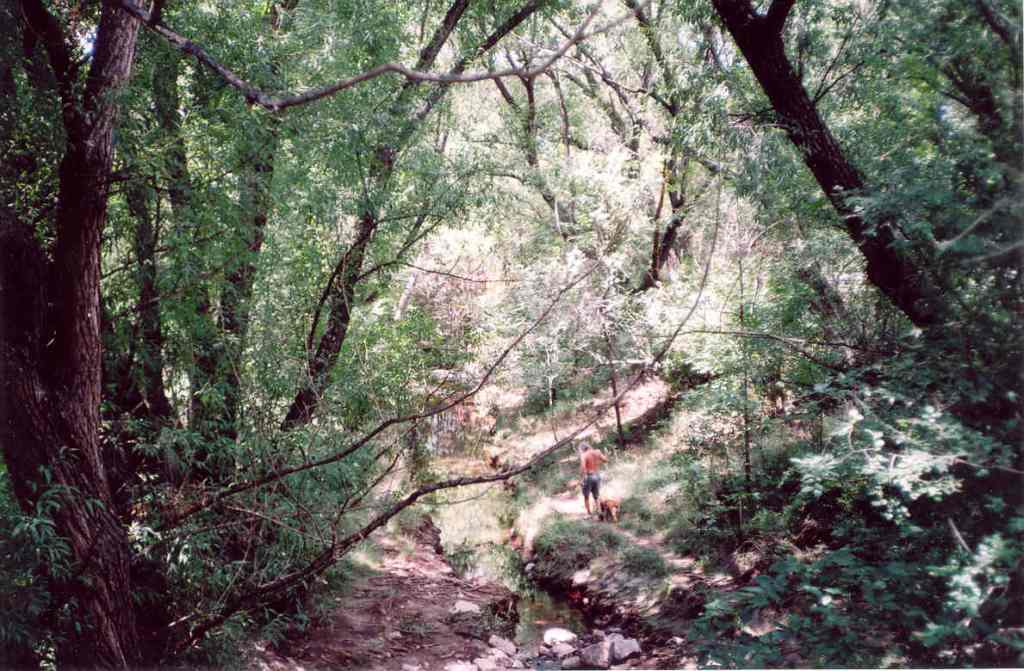
Meanwhile, a Mr. B.A.P. Eaton, superintendent of El Paso County schools, and his wife Margaret had just retired to bed. Known as “alphabet soup Eaton” by the students in the northern part of the district, the kids in the Cheyenne schools simply called him “Bap.” The couple lived at Wahsatch and Yampa in a house that was then at the northeastern edge of town. About 10 o’clock p.m. Eaton heard a roaring sound just north of his house. Peering out the window he witnessed a wall of water illuminated by lightning flashes come barreling in from the north.
The flood swept away the chicken coop and barn, and began swirling around the house. Mr. Eaton dressed quickly as the house was raised off its foundation and began to move in a southeasterly direction towards the low-lying Shooks Run. It struck the northeast corner of Mr. North’s carpenter shop, tearing off the end and the side and continued on.
By this time the man of the former house (or is that the other way around?) knew that they must swim for it. He jumped out the front door into waist-deep water. His wife refused and threw herself on to a bed near the door.
By the time Benjamin Eaton had regained his footing, the house with his wife had floated out of sight and–according to the testimony of eyewitnesses–began to turn and roll over by the time it reached Shooks Run near the present-day Dale Street footbridge. Joseph Dozier said the house struck the Bijou Street Bridge.
Meanwhile Eaton had made his way to a spring wagon that stood on higher ground and was trapped against a post. He was rescued by dairyman Melvin M. Sinton, who threw him a rope from horseback and pulled him to safety. The search for Mrs. Eaton continued through the night and the next day, without success.
The flood destroyed livestock and produce of every farmer, rancher and dairyman who lived or had lands along Shooks Run. Parts of buggies, carriages and wagons were found embedded in the creek bank. A husk mattress that may have been the Eaton’s was found in Col. DeLa Vergne’s oat field in Ivywild, south of Fountain creek.
The body of Mrs. Eaton was found 13 days after the great flood in a pile of driftwood and debris that had been caught on a barbed wire fence on the old Treadwell ranch about two miles south of the city limits.
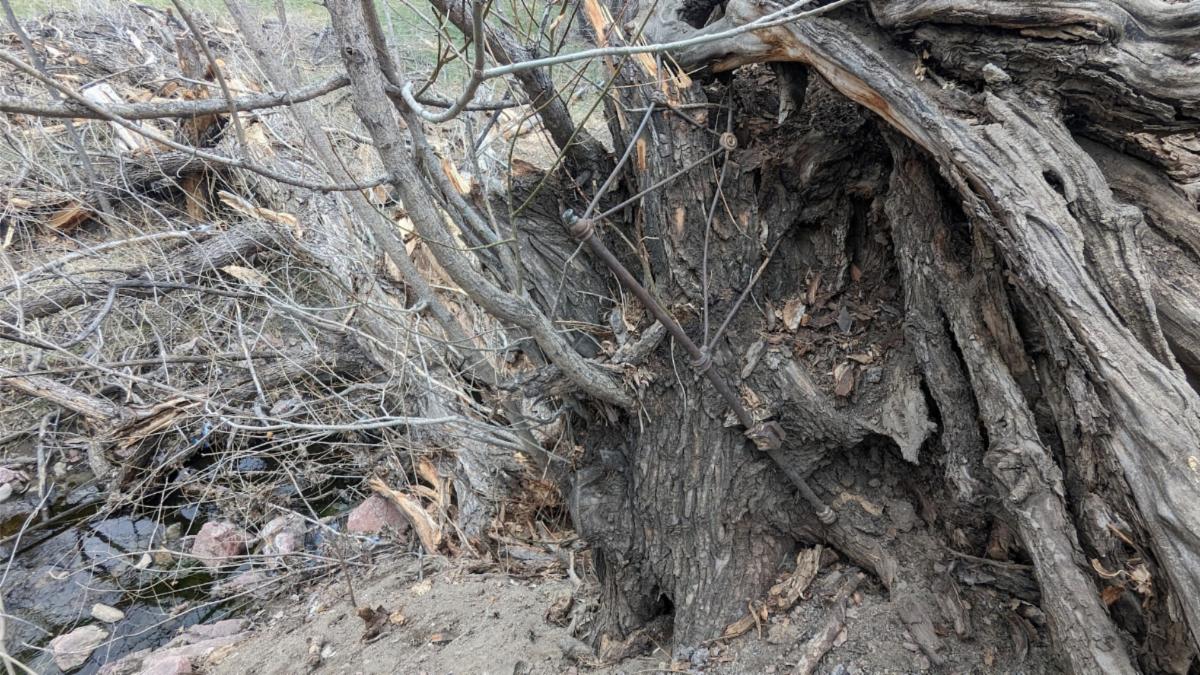
Whether the old bed in the Shooks Run willow belonged to the Eatons, no one knows for sure. One thing that is certain is that by the time someone tried to remove the bedframe from the tree, the fast growing willow had begun to surround it.
Sadly, the tree that embraced the bedstead fell across the creek, a victim of old age, erosion, and wind in 2023.
The Shook Brothers
History from the landmark boulder located in Shooks Run Park
In 1865 two young Iowans, Peter and Denton Shook, settled on 80 acres of land around the confluence of Shooks Run and Fountain Creek to ranch cattle. They were among the area’s earliest pioneers. Soon other early settlers began calling the creek Shooks Run. By a century later, the neighborhood identified itself as Shooks Run.
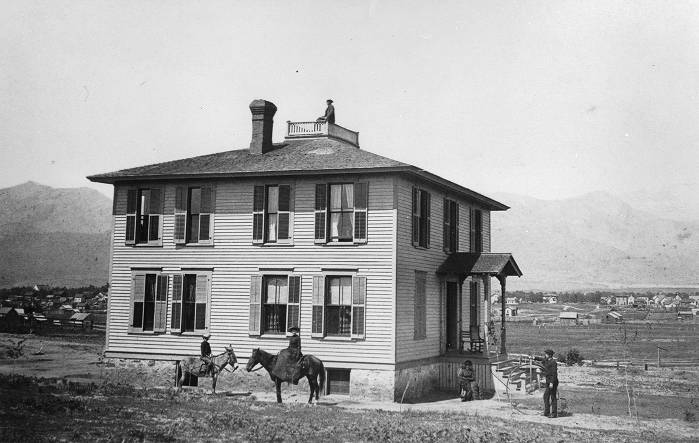
A mile north of the Shook brothers’ ranch, Melvin Sinton, a new settler from Ithaca, New York, established a dairy in 1880 south of Willamette and east of Corona. During that decade he and his brother George ran cows on the east side of the area into a new location on South El Paso Street.
The earliest cottonwoods planted in the Shooks Run area were part of city founder General Palmer’s pioneering forestation efforts.
Institute Street and Electric Streetcars
Institute Street is named for the Colorado School for the Deaf and Blind located between Platte Avenue and Pikes Peak Avenue, Institute and Hancock Streets.
Electric streetcar lines on rails provided public transit in the small city of Colorado Springs starting just before the turn of the 20th century. In 1902, a new extension to the streetcar lines was laid to serve the area north of Platte Avenue and east of the Santa Fe tracks which was beginning to fill up with homes.
By December 1902, the Institute line from downtown, ran east on Pikes Peak to Institute Street, then turned north on Institute to the terminus at Uintah Street. Knob Hill trolleys ran east-west starting from the terminal on Colorado Avenue, turning north on El Paso to Platte Avenue, ran two blocks east on Platte to Institute then north to Boulder, then east on Boulder to Union, then south to a loop terminal at the Union Printers Home.
As the years passed, the street railway saw improvements and passenger use peaked around 1916 or 1917. When the Atchison, Topeka & Santa Fe Railway (which partly followed the course of Shooks Run) completed a new, Tudor-style station in downtown Colorado Springs, an underpass for traffic on East Pikes Peak Avenue was built. This allowed the Institute and Knob Hill streetcar lines to pass underneath the railway. In 1921, when the city and affected property owners agreed to pave Platte Avenue, CS&I moved its tracks on the Knob Hill line one block north to Boulder Street rather than pay its share of the paving cost.
From 1917 on, the streetcar company struggled financially with the increasing use of private automobiles for transportation. By 1932 (April 30), CS&I ended operations, replaced by the Colorado Springs Bus Company. And so ended the age of electric streetcars in Colorado Springs.
Frank Waters, Author, Grew Up in Shooks Run
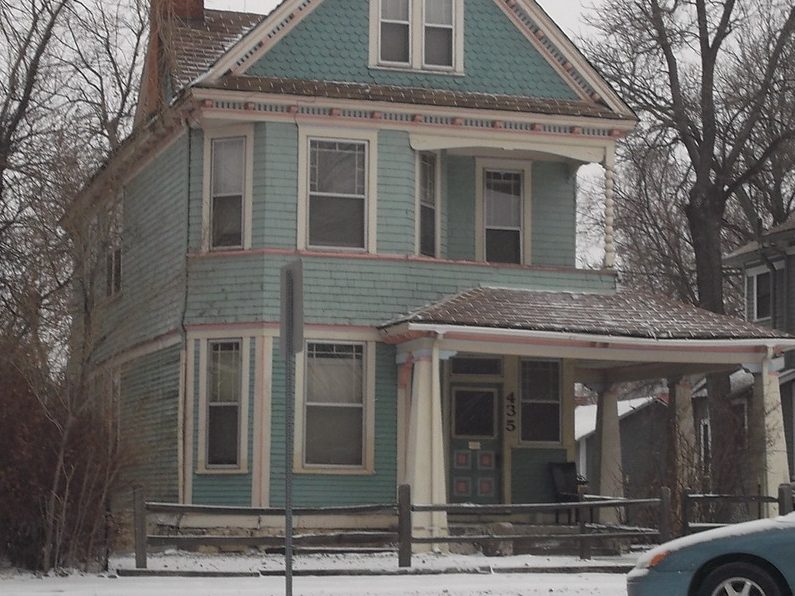
The house at 435 E. Bijou was home of Frank Waters’ grandfather Joe Dozier and his family, locale of a good deal of Waters’ Pikes Peak trilogy. It’s poignant to look at the 1882 plat (map of that neighborhood), and think of the Doziers coming from South Carolina when meat hunters were still butchering buffalo beside Shooks Run right there. Dozier was locally well-known as a builder and carpenter. Dozier kept horses in the back yard just west: the lots ran deep in the N-S direction; Prairie Dog O’Byrne lived on Bijou across Corona Street and may have kept his elk there some of the time but that’s another story.
Who was Frank Waters? From Wikipedia:
Frank Waters was born on July 25, 1902, in Colorado Springs, Colorado to May Ione Dozier Waters and Frank Jonathon Waters. His father, who was part Cheyenne, was a key influence in Water’s interest in the Native American experience. Frank Jonathon Waters took his son on trips to the Navajo Reservation in New Mexico in 1911, described by Frank in his book The Colorado. Frank’s interest in his Indian roots was partially a reaction to his father’s death on December 20, 1914, when young Frank was twelve years old.
Waters continued his education at Colorado College in Colorado Springs. He studied engineering but left school before receiving a degree. Immediately after leaving college, Waters took a job with the Southern California Telephone Company, working in Los Angeles and the surrounding area. Between 1925 and 1935, Waters worked on his first novel, Fever Pitch (1930) and a series of autobiographical novels beginning with The Wild Earth’s Nobility (1935). In 1936, Waters left L.A. and moved back and forth between Colorado and New Mexico, continuing to write and completing a biography of W. S. Stratton, Midas of the Rockies, a Colorado Springs carpenter who became a millionaire from his Independence gold mine in Victor, Colorado. Waters became close friends with Mabel Dodge Luhan and her husband from Taos Pueblo, Tony Luhan.
When World War II broke out, Waters moved to Washington, D.C. to work for the Office of the Coordinator of Inter-American Affairs. There he performed the duties of a propaganda analyst and chief content officer and, although he was released from the army in 1943, he continued to work for the Office of the Coordinator of Inter-American Affairs. Waters’ masterpiece, The Man Who Killed the Deer, was published in 1942.
It’s well worth finding a copy of Pikes Peak trilogy (published in 1972) and travel back to Colorado’s early days.
Historic Church – 527 E. Saint Vrain St.
People’s Methodist Episcopal Church – People’s Methodist Church – Independent Missionary Baptist Church
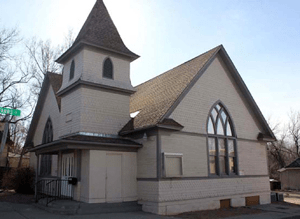
In what was then a predominantly Black neighborhood in Shooks Run, the 1904 church served its African-American congregation until 1965 when the congregation relocated to Boulder Street Church at 828 E. Boulder.
Embodying Queen Anne and Gothic Revival style elements, the building is one of the city’s oldest wood-framed and clad churches. Early members included Frank Loper, Jesse Bass, and Lonnie Bassett. It served as the local headquarters for the Universal Negro Improvement Association (UNIA) established in 1914 by Marcus Garvey. Garvey visited the church in 1922 and with his second wife, Amy Jacques Garvey, in 1924, when she delivered the sole address to the Colorado Springs division at the church.
The devastating May 30, 1935, flood that destroyed bridges on Monument Creek also flooded Shooks Run and adjacent homes and the church, rendering the church’s basement unusable for at least a year.
The building is listed on Colorado’s State Register of Historic Properties and the National Register of Historic Places. In 2022-23 the building is being converted to residential use.
 Middle Shooks Run Neighborhood Association